Home / Products / Roller Blinds
Roller blinds, measured to the millimetre for promenade glass
The most-fitted product on our books, and the one Mouille Point's floor-to-ceiling windows were practically drawn for: one clean tube of fabric, sized to your exact opening, in a weave chosen for what your particular window does at four in the afternoon.
Why this is the promenade's default blind
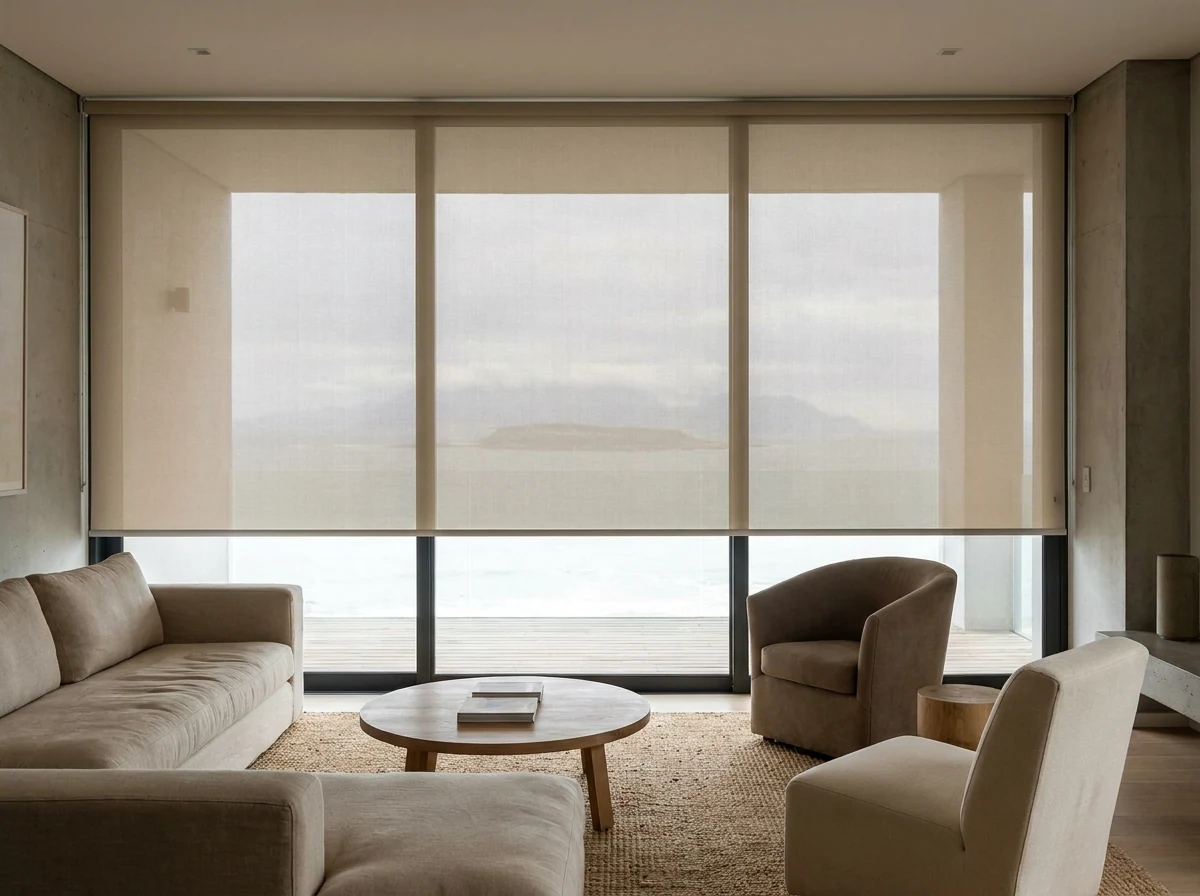
Walk the beachfront blocks between the lighthouse and the stadium and you'll spot them in window after window: plain rollers, no pelmets, no fuss. There's a reason. Mouille Point's apartment glazing runs big, square and frameless, and a roller blind is the one product that disappears into that kind of opening — a slim tube at the top, a flat plane of fabric below it, and nothing competing with the water. It's also the easiest product to motorise, repair and re-fabric later, which matters in buildings where blinds outlive tenants.
Three fabrics, three different jobs
Every roller we quote here lands in one of three camps, and the right camp depends on the room, not the catalogue.
Sunscreen mesh
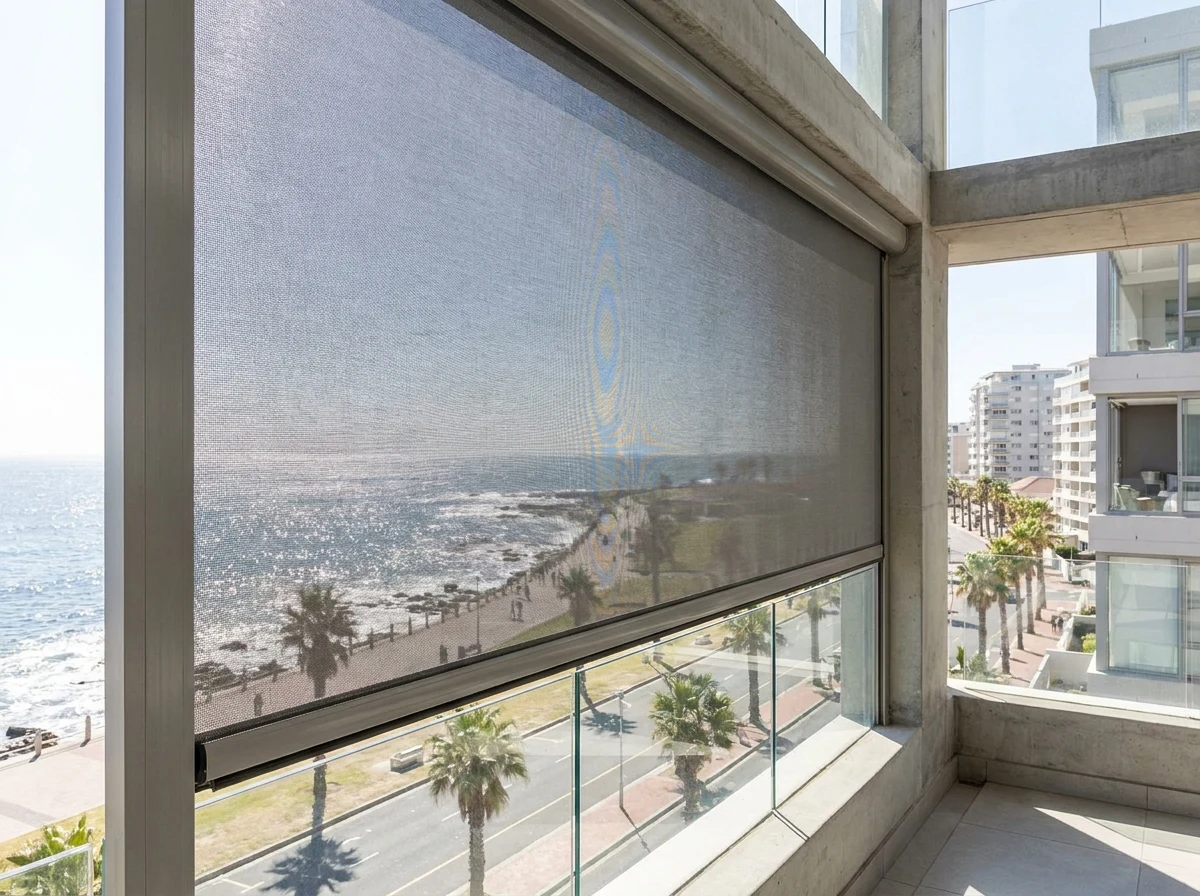
A woven fabric with a measured openness — 3%, 5% or 10% — that tames reflected light off the bay while the outline of Robben Island stays put. The tighter the weave, the harder it works and the softer the view. Lounges facing open water usually sit at the tight end.
Blockout
A coated fabric that passes no light at all. This is the bedroom answer — the promenade's street lamps and the harbour's glow stay outside — and it doubles as insulation on glass that leaks warmth once the winter north-wester arrives.
Double roller
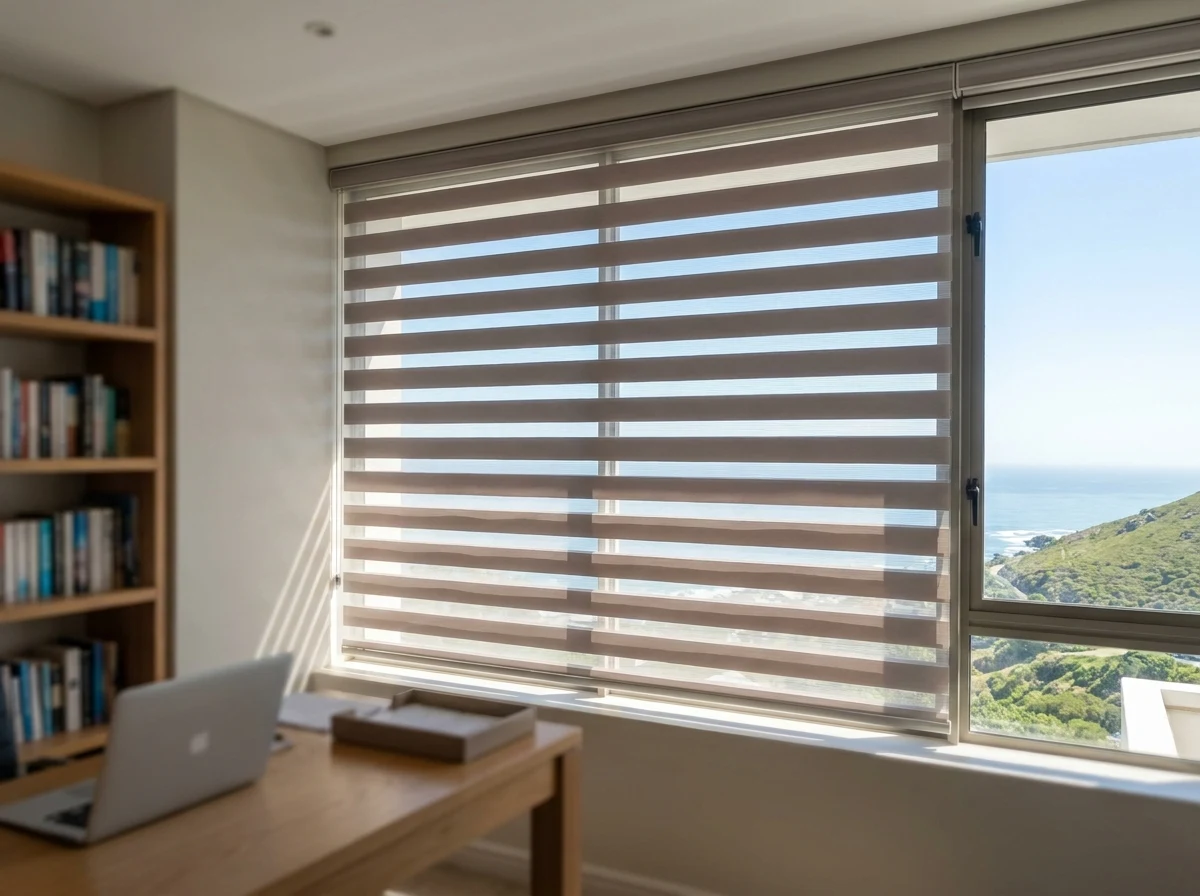
Both of the above on one bracket: sunscreen for daytime, blockout for night, each on its own tube. The usual pick where a single room has to be a lounge at noon and a sleeping space at eleven.
Control options
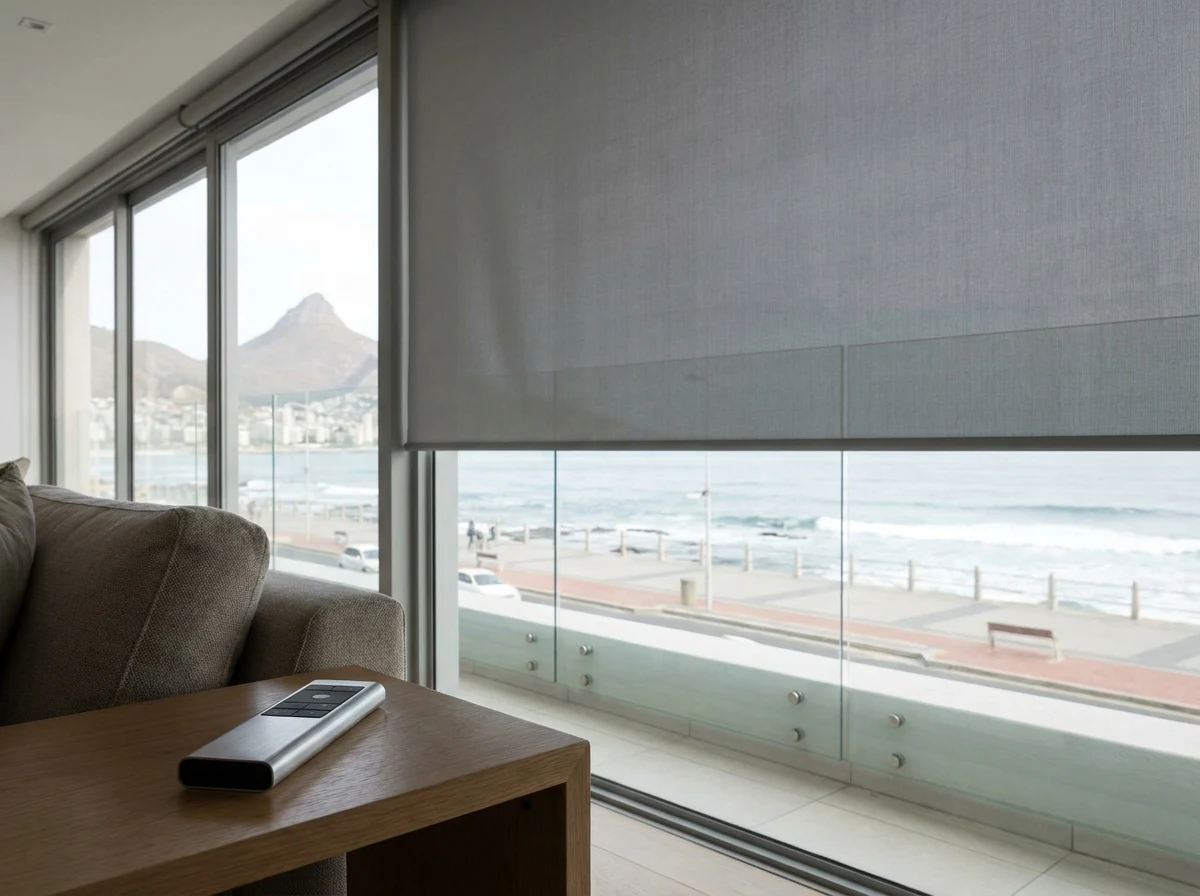
Chain with a child-safe tensioner, spring assist, or a battery motor — the retrofit route that needs no electrician, no wall chasing and no wiring approval from the body corporate.
What sitting beside Table Bay does to the spec
Salt is the quiet enemy of window hardware on this strip. Anything we fit near a balcony door or an openable pane gets a sealed cassette instead of exposed brackets, and metal components come powder-coated for coastal use — the difference shows up two winters from now, not on install day. The other local constant is width. Floor-to-ceiling glazing routinely runs past the width one chain can comfortably drive, so a wide wall of glass is either split into paired blinds with a deliberate centre line or run as linked, motorised tubes that move as one. The width problem and the salt problem follow us right along this coast — the high-rise glazing we measure in Sea Point is where a single tube runs out of road, and the cliff-edge blocks of Bantry Bay are where coastal hardware stops being optional.
Where the pricing sits
Rollers are worked out on area: R1,000 to R1,600 buys a square metre of chain-driven blind, fitted, with plain blockout toward the first number and a view-holding mesh, or two cloths sharing one bracket, toward the second. Motorise it and R2,500 to R3,800 buys that square metre, the tube motor, your choice of handset or wall control and the commissioning all inside it.
Two things bend the arithmetic. A small opening needs the same tube, salt-rated brackets and building access as a large one, so those bill at a minimum. And a spread is a planning device: each window on your list is costed separately once a consultant has measured, and confirmed on paper before anything is ordered.
- Made to the measured opening — no stock sizes, no trimming on site
- Coastal-grade, powder-coated componentry as the default, not an extra
- Sealed cassette recommended near balcony doors and openable glass
- Wide glazing split into pairs or run as linked motorised tubes
- Child-safe tensioners fitted on every chain, every time
Worth knowing before the measure
Can people on the promenade see in through a sunscreen blind at night?
Honestly, yes — sunscreen mesh works by relative brightness, so once your interior lights are brighter than the sky outside, the effect reverses and the room becomes visible. That's exactly why ground-floor and first-floor units facing the walkway usually take a double roller: mesh for the day, blockout for the evening.
How do I choose between 3%, 5% and 10% openness?
By what the window faces. Glass looking straight over open water takes the most reflected light and usually wants 3%; a unit set back from the seafront or facing up a side street can afford 5% or 10% and keep a crisper view. The consultant brings sample swatches to hold against your actual window, which settles it faster than any rule of thumb.
Our sliding door is over three metres wide. Is that one blind or two?
Usually two, or one motorised pair linked to move together. Fabric is milled in fixed widths and a single oversized tube puts real strain on a manual chain, so past roughly three metres we'd rather engineer the join deliberately than pretend the limit isn't there. Where the opening allows a single motorised tube, we'll say so in the quote.
Can you re-fabric an existing roller instead of replacing it?
Often, yes — if the tube and brackets are sound, new fabric onto existing hardware is a fraction of a full replacement. Salt-corroded components are the usual disqualifier this close to the bay, and the consultant will tell you plainly which side of that line your blinds fall on.
Put a consultant in front of your glass
Sample swatches against your own window, every opening measured, and an itemised price per blind — all free of charge.