Almost every shading guide written for this coastline assumes you are above things — up a slope, up a cliff, up eleven floors. Mouille Point is the exception. A great many flats here sit at or near the level of a public walkway that is busy from before dawn until long after dark, with nothing but a pane of glass and a few metres of paving in between. That changes the brief completely, and this guide is written for it.
Short on time? Grab the PDF and come back to it — 13 pages.
One
A street with the sea on one side and the city on the other
Mouille Point is a thin ribbon of buildings along Beach Road, tucked between Green Point behind it and the rocks in front, facing straight out into Table Bay.1 Its landmark is the candy-striped lighthouse standing on the seaward side of the road, first lit in 1824.2 The bay opens to the north, so the horizon in front of these windows runs unbroken from the north-east right round past west, with no headland, ridge or neighbouring suburb interrupting any of it.
Two things follow, and they pull in opposite directions.
The first is that the outlook is superb and nobody wants to give it up. The second is that the paved public walkway running between the buildings and the water is one of the most-used pieces of open space in the city, and it does not close. Joggers before sunrise, families all afternoon, dog walkers and couples well into the evening. On a low floor you are not looking at a view so much as sharing a room with a street.
Almost every Beach Road brief is really two briefs at once: keep the bay, lose the audience.
Higher up, the audience disappears and the exposure takes over. Both halves of the suburb are covered here, but the low floors come first, because that is where the mistakes are expensive.
Two
What happens at dusk, and why it catches everyone
Here is the single most useful thing on this page, and it is the thing we end up explaining in almost every consultation on this street.
A sunscreen mesh works on a difference in brightness. During the day the outside is far brighter than the inside, so you see out through the weave clearly and nobody walking past sees anything but reflected sky. It feels, entirely reasonably, like a privacy product.
Then the sun goes down, you switch a lamp on, and the brightness difference reverses. Now the room is the lit side. The same mesh that was opaque from the promenade at four o'clock is close to transparent at eight, and the person on the path can see your lounge in some detail while you can see nothing at all beyond the glass.
This is not a fault in the fabric and it is not a question of choosing a better mesh. It is simply how an open weave behaves, and no openness percentage escapes it. What it means is straightforward:
Any window overlooked by the walkway needs two states, not one. An open layer for the day and an opaque layer for the evening — whether that is a double blind on one bracket, a banded fabric you can slide closed, or vanes you can turn right shut.
Test it yourself before you commit. Stand outside on the path after dark with the room lights on and look back at your own window. Twenty seconds settles an argument that otherwise gets settled after installation.
It is worse on this street than most. Because the promenade stays busy after dark, the hours when your glass is the lit side are exactly the hours there are people on the other side of it.
The path is that close. Vanes turned to an angle cut the sightline from someone walking past while leaving the flat its light and its water — and they draw fully aside when the doors are open.Three
Your room is lit from three directions
People shade for the sun and are then puzzled that the room is still uncomfortable. That is because on this road only one of the three light sources is above you.
From the sky
The obvious one. Direct sun through the opening, high in summer and low in winter. A balcony slab or an overhang deals with the high version and does very little about the low one.
Up off the water
Table Bay is a large flat moving mirror sitting right in front of you, and on a bright day it throws light back upward into the room. That light travels under an overhang, under a balcony slab, and under the bottom rail of any blind you have only pulled halfway down. It is the complaint we hear most often here, and the only place to meet it is at the plane of the glass, over the whole opening.
Back off the street
Pale paving, white parapet walls, parked cars and the building opposite all return a diffuse second-hand light into flats that never see the sun directly. It is soft rather than harsh, but on a low floor it is why a north-lit room can feel bright and still feel on display.
The practical consequence is a habit rather than a product: on a sea-facing window, run the fabric the full height of the opening rather than stopping it at the top of the view. A blind held at half-mast on Beach Road is leaving the water's contribution completely unanswered.
What a well-chosen openness actually looks like: the glare has gone, the fabric covers the whole opening rather than the top half of it, and the island is still perfectly legible through the weave.Four
The sunset moves along the horizon through the year
Stand at the same Beach Road window in December and again in June and the sun will go down in two noticeably different places. That travel is worth understanding, because it decides which of your rooms has a problem and in which season.
At the December solstice the Cape Town sun sets on a bearing of roughly 240 degrees — south-west, which from here is inland, behind the buildings and the high ground rather than over the water. At the June solstice it sets around 297 degrees, out to the north-west, straight down the open bay.3 Between those two dates the sunset point walks nearly sixty degrees along your horizon and back.
So the seasons behave backwards from what most people expect on a coastal street:
Midsummer evenings are easy. The sun is high through the day and drops away behind the land at the end of it. The heat is real, but it is not coming at you horizontally through the glass.
Midwinter evenings are the hard ones. A low sun, an unbroken run of water, and a sunset sitting almost exactly in the middle of a sea-facing window. This is when the phone rings.
The room that suffers changes with the season. A flat with glass on two elevations often has one problem window in February and a different problem window in July, which is why we would rather look at a whole flat than quote one opening in isolation.
If you take one action from this section, take this one: note the date and the time when the room becomes unusable, and tell us. Two data points beat any amount of description.
Five
A flat street in a strong wind
Beach Road has nothing on it to break the weather. The wind that shapes a specification here is not the summer south-easter everyone talks about — it is the winter one, and it arrives from the opposite quarter.
Table Bay is open to the north and north-west, which is exactly where the Cape's winter fronts come from. That is old knowledge, not a modern observation: for much of the colonial period shipping was moved out of Table Bay for the winter months and round to the sheltered Simon's Bay on the False Bay side, because the north-westerly gales made this anchorage genuinely dangerous.45 Your balcony stands in the weather that emptied the bay.
Three rules follow, and we apply them without exception:
Outside, the fabric is captured on both edges. An exterior screen on this road runs in aluminium side channels along its full height, so there is nothing loose for a gust to lift. If an opening cannot take channels, we would rather propose something else than hang a blind that flogs itself apart in one front.
Anything that retracts gets a wind sensor. The gust that damages an awning arrives on a Tuesday afternoon while you are at work. A sensor pulls the fabric in without being asked, and it costs a small fraction of the thing it protects.
Inside, kill the rattle before it starts. A chain-operated blind in front of a window you like leaving open will knock against the reveal all day, and a blind that knocks gets tied back and never used again. A weighted bottom rail or slim side channels solves it for very little at the time of order — and almost nothing after the fact.
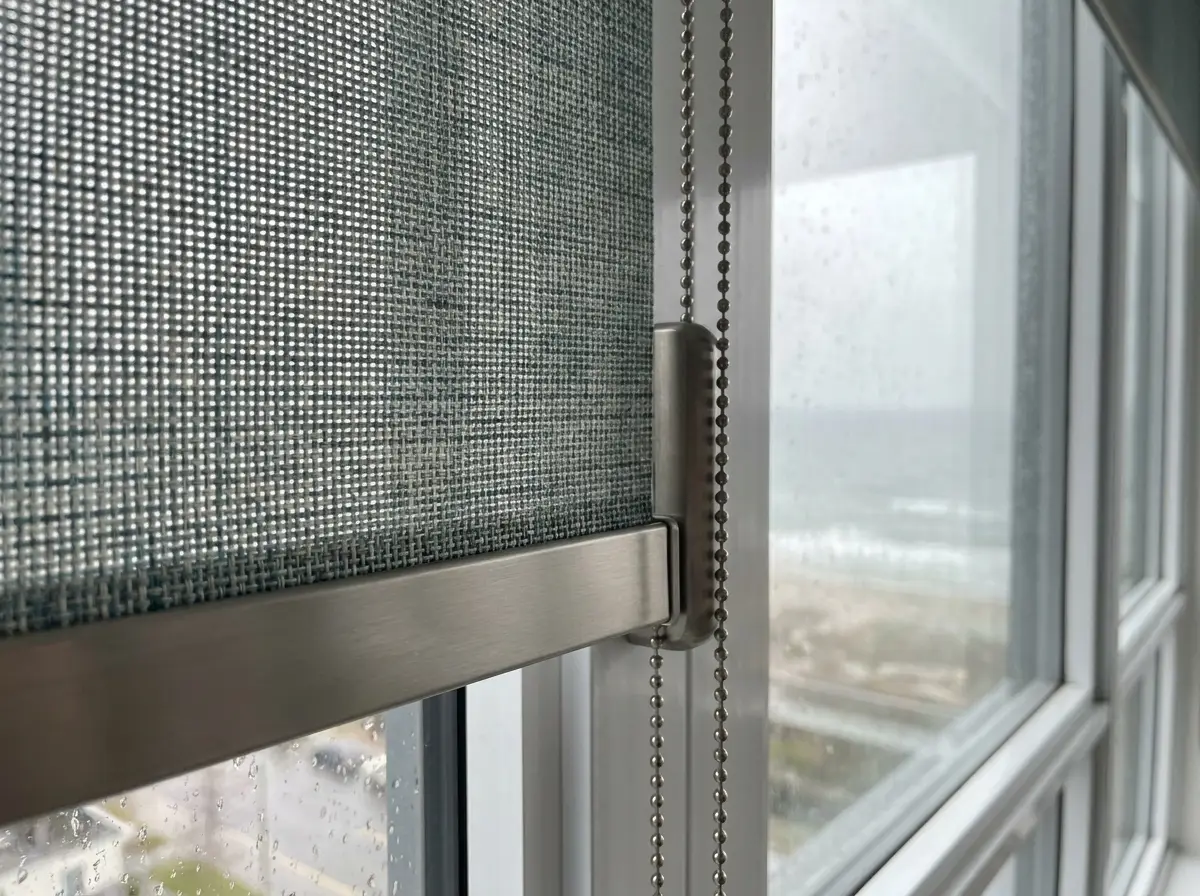
Two details that matter more than the fabric on this street: the channel running down the edge of the opening, which is what stops a screen lifting, and the small sensor beside it, which is what brings the screen in while nobody is home.Six
Salt, and the one small job we will ask of you
Salt does not reach your flat as a splash. It leaves the surf as a fine airborne mist and the wind carries it — up the face of the building, across the road, in through an open window and onto the inside of a bracket you will never look at. A high balcony is not out of range; it just gets a different dose.
So the coast is specified into everything we fit on this road: powder-coated aluminium rather than painted steel wherever the outside air reaches it, closed heads and sealed cassettes on exterior products, coastal-grade fixings as standard rather than as an upgrade, and glass-fibre-cored sunscreen mesh, which handles sea air far better than a soft woven cloth and does not stretch when it goes damp.
And then one thing from you: rinse anything exposed with fresh water a few times a year, and wipe down the head rail. A hose on a balcony, or a bucket and a cloth. It takes ten minutes and it is the difference between hardware that lasts and hardware that seizes. We would rather tell you that now than describe anything on this coast as maintenance-free.
Seven
Cold glass in July
The winter complaint on this road usually has nothing to do with sun. It is a bedroom window running with water in the morning, most often in an older block with single glazing.
What is happening is not a fault. Warm indoor air carries moisture, and sea air supplies it generously. Glass is the coldest thing in the room by a wide margin, and air that touches something cold enough gives up its moisture onto it. That is all condensation is.
Habits do most of the work here — an extractor that genuinely vents outside, lids on pots, and no wet washing drying behind a closed bedroom door. Air movement matters too: cracking a window open for a short spell morning and evening beats sealing a damp flat shut, which only makes it damper.
What a blind adds is warmth on the cold surface. A cellular honeycomb fabric holds a layer of still air between itself and the window; drawn down overnight inside the reveal, it keeps the room's heat on the room's side and takes the chill off the glass — and the glass was where the water was collecting. It is the one thing we fit on this road that has nothing whatever to do with the sun.
Where we stop. A blind reduces condensation on glass. It does nothing for a damp wall, a failed window seal, or water tracking in around a frame. Those are repairs, they belong to the building rather than to the window, and you will be told so instead of being sold fabric to cover them.
Eight
What a Beach Road specification looks like
Putting the whole thing together. This is a starting point for a conversation, not a quote — every line gets revisited at the window.
Low floor facing the walkway:day and night bands, or vertical vanes on a full glass wall — plus something genuinely opaque for the evening.
Sea-facing living space above the walkway: a pale sunscreen roller run full height, coastal fixings, motorised if the opening is wide or out of reach.
Sea-facing bedroom: a double roller — mesh by day, blockout by night, one bracket. And be clear about dark: every blockout fabric is opaque, so what wakes you is the light at the edges. Side channels, not a heavier cloth.
A balcony you want to use in wind: a guided zip screen, sensor fitted.
An elevation that genuinely overheats: shading outside the glass — an external slat blind or a roller shutter — because heat stopped in open air never becomes heat in the room. This is the most capable thing we fit and the one that has to be drawn, specified and agreed with the trustees first, since it changes the outside of the building and that is common property.6
Cold single-glazed rooms: a cellular fabric in the reveal, closed at night.
Kitchens and bathrooms: aluminium slats — wipeable, with nothing for salt or steam to settle into.
Everywhere: child-safe controls, and motorisation on anything you cannot reach comfortably, because an awkward blind is an unused blind.
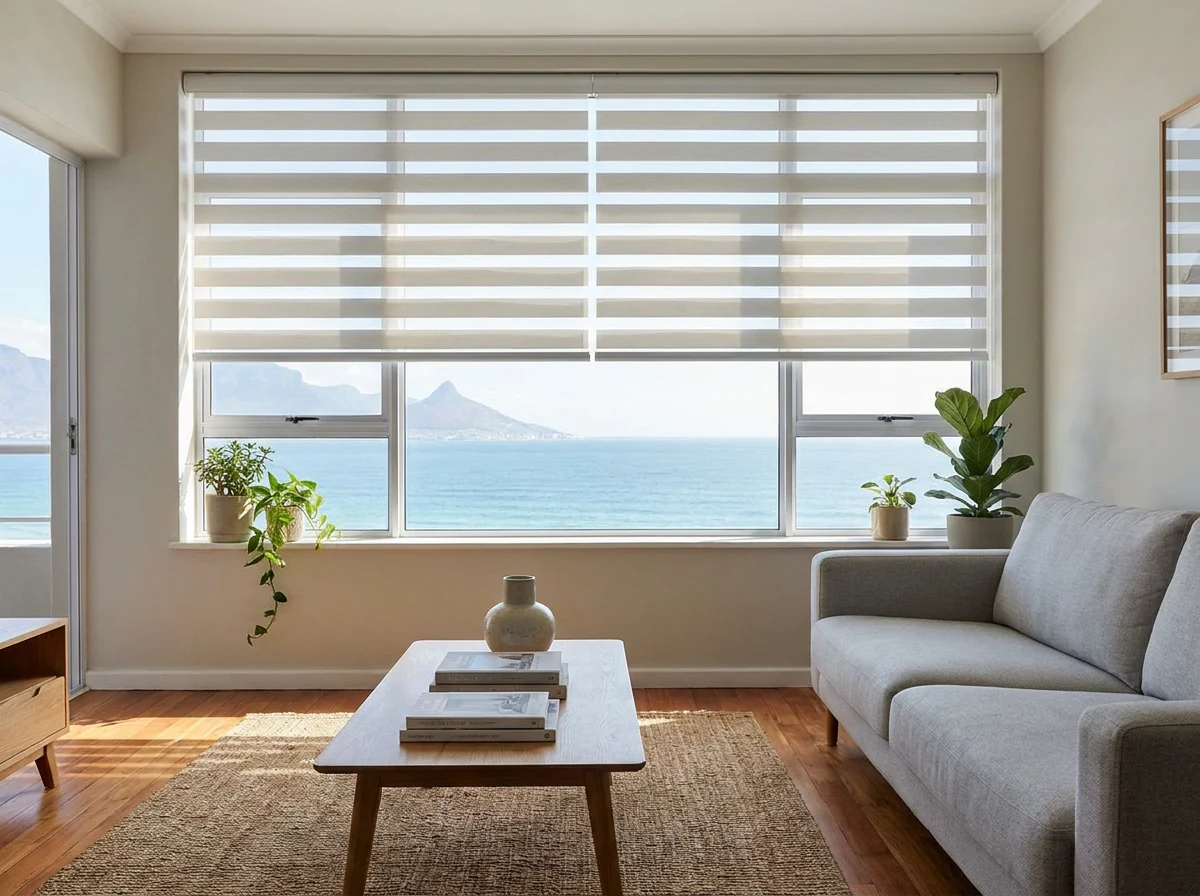
Bands set to sheer: privacy from anyone at the same height, the horizon still there, and the lower panes left clear. Slide the same blind a few centimetres and it closes right up for the evening — which is the two-state answer section two was asking for.Nine
Three things we settle at the window itself
Everything above is reasoning from geography and physics. These are not, and they usually change the answer:
What the opening will actually hold. A frame you can fix a screen to, a slab edge with sound structure behind it, plaster that has been patched three times — each dictates a different fixing, and sometimes a different product altogether. Two minutes in person; pure guesswork from anywhere else.
What your building already permits. Many schemes along this road have long-settled rules on colour and profile for anything visible from outside, and knowing yours before you choose saves a wasted round of thinking. We hand over the written specification in a form you can give to trustees, and we do not order until that is resolved.
Exactly when the room stops working. The date and the hour, not "the afternoon". That one sentence from you narrows the specification faster than anything else on this page.
The measure costs nothing and commits you to nothing. Real swatches come to the flat, because a mesh held up against bay light behaves nothing like the same mesh on a screen, and every opening is measured by hand. Afterwards you get a written price against each opening separately, so you can weigh them one at a time rather than as a single number.
Your free measure
Start with the window that is wrong
Tell us the room, roughly which way it looks, and the time of day and year it stops working. One of our expert consultants will contact you shortly to arrange your free in-home measure.
No obligation, no call-centre — a consultant calls you directly
Fabric samples brought to the measure, not just a screen swatch
Written, itemised quote before anything is ordered
Sources
The checkable bits
The dates, bearings and history above all came from the six public references below. Go and check them. What we suggest hanging in front of your glass is judgement rather than fact, and it is offered free.
Wikipedia — Mouille Point (the narrow coastal suburb along Beach Road between Green Point and the harbour, fronting Table Bay).
Wikipedia — Green Point Lighthouse (first lit in 1824, standing on Beach Road in Mouille Point, with its red and white diagonal banding).
Gaisma — Cape Town sun and moon data (sunset bearings of roughly 240° at the December solstice and 297° at the June solstice, and the seasonal solar altitudes quoted here).
Wikipedia — Table Bay (the bay's northward exposure and its historic reputation as an unsafe winter anchorage).
Wikipedia — Simon's Town (the seasonal move of shipping to the sheltered Simon's Bay during the winter months, because of the north-westerly gales in Table Bay).
Community Schemes Ombud Service — csos.org.za. Where sectional-title arguments about the outside of a building end up when trustees and owners cannot settle them between themselves.
Read this as guidance, not as permission. Whether something may go on the outside of your building is your trustees' call and nobody else's; anything structural, and anything to do with water getting into a wall, needs a qualified professional to look at it. What we can do is put the specification in writing so you have something solid to hand over.